Sunday, March 27, 2011

Link Potpourri: for discussion

I am hoping to keep up a bit better with this blog as well as on my new personal blog, Rogue JD. With that in mind, here are some links of interest that Thalia and I have been discussing lately.

What If Black Women Were White Women?

This is a fantastic satiric analysis of sexual and racial stereotypes, written on the model of Gloria Steinem's "If Men Could Menstruate." It asks, "What if suddenly, instantly, the power of white femininity were transferred to black women?"

Movies would feature black women as the main objects of men’s desire across racial lines while stereotypes of evil, bitter, and oversexed white women would further prove why men of all races simply did not prefer blonds. “We can’t help those to whom we're attracted,” men would say. “Preference” would become an unconcealed acceptance of discrimination against white women. White women’s anger towards and sadness about the status quo would show their unreasonable jealousy of the innate superiority of black women.

Republicans would ban abortions to protect the virtue of pure, black motherhood and liberals would advocate increasing the number of abortion clinics in “low income” neighborhoods where white women would be the majority. Liberals would claim that white women had “culturally” approved of sexual objectification and were “safe enough” without outside help since they were warned not to touch “in-group issues” with a ten foot pole.

...As Gloria Steinem wrote, “In short, the characteristics of the powerful, whatever they may be, are thought to be better than the characteristics of the powerless - and logic has nothing to do with it.”


Posting this link on Facebook resulted in some pretty impressive racism denial and derailing from at least one white male commenter, but also brought out some thoughtful comments. A lot of my thoughts about this link actually concern the reactions and interactions from our peers to the article. I challenged the racism-denier, but never felt like I got through to him, and the exchange was certainly no more satisfying to him. He resorted to ad hominem arguments--calling me ignorant and simpleminded--while continuously asserting his own claim to victimhood as a "demonized" white male. Perhaps Thalia can make some suggestions of more productive means of having this kind of conversation, as that is her area of study?

On a more positive note, here is an example of a male game developer nailing the operation of privilege. In response to a straight male complaint about the depiction of homosexual relationships in Bioware's Dragon Age 2, developer David Gaider takes down the complaint with an appropriately sharp rebuke:

The romances in the game are not for “the straight male gamer”. They’re for everyone. We have a lot of fans, many of whom are neither straight nor male, and they deserve no less attention. We have good numbers, after all, on the number of people who actually used similar sorts of content in DAO and thus don’t need to resort to anecdotal evidence to support our idea that their numbers are not insignificant… and that’s ignoring the idea that they don’t have just as much right to play the kind of game they wish as anyone else. The “rights” of anyone with regards to a game are murky at best, but anyone who takes that stance must apply it equally to both the minority as well as the majority. The majority has no inherent “right” to get more options than anyone else.

...And if there is any doubt why such an opinion might be met with hostility, it has to do with privilege. You can write it off as “political correctness” if you wish, but the truth is that privilege always lies with the majority. They’re so used to being catered to that they see the lack of catering as an imbalance. They don’t see anything wrong with having things set up to suit them, what’s everyone’s fuss all about? That’s the way it should be, any everyone else should be used to not getting what they want.


PWNED! It is tremendously encouraging (not to mention sexy as hell!) to see a man working in the upper eschelon of a typically whitewashed, straightwashed, and sexist industry telling it exactly how it is. Well played, sir. I salute you and hope you get good royalties, for I certainly plan to purchase this game.

I also want to share this heartrending but ultimately hopeful article about human-elephant relations that I came upon, of all places, through Cracked.com. This is an old NYT article--I wish I could get an update on new developments--but it demonstrates a pet conviction of mine: that human beings and animals are not so very different, and that we are not the only intelligent life on Earth. It tells the story of how human interference and brutality has changed elephant culture for the worse--how they have begun to rape other animals and murder humans with apparent malice aforethought. The article parallels elephant and human victims of genocide, and sheds light upon the damage wrought by zoos and misguided animal management. It also, to my mind, says a lot about how humans as well as animals are harmed by violence.

Finally, an economic justice link. Losing Our Way, Bob Herbert's last NYT column, speaks eloquently of the times we find ourselves in. "The U.S. has not just misplaced its priorities," he writes. "When the most powerful country ever to inhabit the earth finds it so easy to plunge into the horror of warfare but almost impossible to find adequate work for its people or to properly educate its young, it has lost its way entirely."

Americans behave as if this is somehow normal or acceptable. It shouldn’t be, and didn’t used to be. Through much of the post-World War II era, income distribution was far more equitable, with the top 10 percent of families accounting for just a third of average income growth, and the bottom 90 percent receiving two-thirds. That seems like ancient history now.

The current maldistribution of wealth is also scandalous. In 2009, the richest 5 percent claimed 63.5 percent of the nation’s wealth. The overwhelming majority, the bottom 80 percent, collectively held just 12.8 percent.

This inequality, in which an enormous segment of the population struggles while the fortunate few ride the gravy train, is a world-class recipe for social unrest. Downward mobility is an ever-shortening fuse leading to profound consequences.


I actually can't help but hope that social unrest will erupt in America, because I don't think change is likely to happen within our current political system. I was inspired recently when state union workers revolted in Wisconsin. I think America has forgotten its rebel roots, has forgotten how to stand up. When will it finally remember again? When will it shake off the blinders that cause us to act as if inequality is normal and acceptable? When will we say "enough is enough"?

Monday, February 21, 2011

FA Thinky Thoughts

I've been reading a lot lately about Fat Acceptance. Here are two great links:
http://yrwelcome.wordpress.com/2011/02/01/why-im-fat-positive/#comments
http://slog.thestranger.com/slog/archives/2011/02/11/hello-i-am-fat

and a Thin Girls' Privilege list (a little trite, but still useful):
http://heyfatchick.tumblr.com/post/1296446884

I self-identify as fat. It's cool, I may wish on some days that it was different, but what I actually wish is not that my body was another shape, but that external attitudes about the shape it is weren't so negative. The truth is that I eat better, get more exercise, and am exponentially stronger and more durable than most girls I know.

My body, my metabolism, they're different. I have a thyroid condition that, though regulated now, caused a fair amount of damage before I caught it. I come from curvy, low-to-the-ground ethnic stock, grew up in a low-income household where expensive vegetables often lost out to cheap and easy, starchy fare. And to be fair, when I work out hard over sustained periods, I can slowly start to burn off this extra body mass.

But here's the thing--I'm busy. Really busy. I have exactly zero days off a week, and if I do schedule a day off of work, it's so I can go to an event--so I'm still busy. I don't always, hell, I don't OFTEN have the energy to go to the gym after work. Or before work when I'm trying to squeeze that last bit of sleep out of a too-short night. That's another thing--sleep deprivation is a large factor in weight gain/loss and as a working grad student, sleep deprivation is my theme song. The bottom line is that in a full life something has to give.

And I know the secret is to find balance, blah blah blah. But you know, people don't tell Olympic athletes, "You really should try to work in some calculus, read some classics and stuff in between training sessions--your mind is looking a bit flabby...". They don't tell supermodels, "Honey, your powers of empathy are WEAK!" Fitness is a lifestyle condition that is written on the body. Everyone can tell if you're fat, when it's not immediately apparent to others whether you're functionally illiterate, emotionally immature, a closet speed freak or an asshole.

I can't hide this "failure" and it constantly overshadows my myriad, and way more important other good qualities. The truth is that I have great will-power, but other priorities. I don't need people to tell me, "I don't think of you as fat..." because I am fat. I pretty much always have been, or at least have always felt so. It doesn't tax me overmuch. And I know they're trying to be nice and supportive, but my fatness isn't negative. It's not like I'm unhealthy...my lung capacity is over 100% for my demographic, in spite of allergies and...ahem...chronic bronchitis and my blood pressure and cholesterol are actually on the low side.

I think what FA comes down to is that it's wrong that fat people are the one group it's still okay to bash and make fun of. It's wrong that we're treated as sub-human, sexless and stereotyped as everything from lazy to lacking personal hygiene. Maybe there are health risks associated with obesity--there are also health risks associated with hang-gliding, playing tennis, eating blowfish, driving a car, traveling in third world countries, having babies, and perming your hair. Fatness is not monolithic, it's not the same for every fat person. Some can help, some can't. Some don't want to. Some are so desperate they have surgery, throw up their food, stop eating take dangerous drugs. Some don't do that, but do sit at home feeling worthless and not living for fear of being shamed. Some of us, though, say "fuck you" to fat haters and delight in living full, amazing, joyful, sexy lives and trying to help the aforementioned sad fat folk find the way. And empathizing with them if they can't. And respecting their choice to live however the fuck they choose, because ultimately, it's their life.

For the record, handsome sexy men are often attracted to me. I frequently end up with the guy other girls crush on from afar. And not only am I fat, I often dress like a boy, so how does that line up with the social paradigm? I think the secret is this: I have a healthy sense of self worth and I expect others to treat me in a way that is commensurate with that. The sad thing is that while I know I'm awesome, and I know that the people in my platonic relationships agree, I know that society-at-large can never give me its full seal of approval when I look like this. So I don't worry that men won't be attracted to me--I worry that they'll be ashamed to be seen with, ashamed that the world will know that they aren't repulsed by my generous proportions, that they are, in fact, turned on by my abundant body. It's the third-party reaction that undermines my confidence in my appeal--and it's more powerful than I like to admit. I'm more familiar than I'd like to be with the roles of Just One of The Guys, Wingwoman-For-Thinner (Not Even Always Prettier)-Friend, Friend-With-Benefits-Just-Not-Legitimate-Girlfriend-Status, Invisible Girl and Guilty Pleasure. Very little of that has anything to do with WHO I am...it's all about the WHAT. Which is pathetic, and makes my being fat a very effective social tool for weeding out the worthless, weak, and superficial.

There's a really weird cultural thing about fat that ties in with that RSAnimate short on communication and collective knowledge. I know I'm fat. Everyone else knows I'm fat, but if we don't talk about it, I might believe that they don't really THINK I'm fat. Or they might think that I'm delusional. If we quietly ignore that I don't get treated like a fat person by those around me, maybe it means...I'm not fat? Or that with the power of my will and charisma I can overcome Newton's Third Law of Social Fattitude? I don't know for sure. I do know that I'm reluctant to post FA links on FB. And I'm a little conflicted about what that might mean.

I've grown up in this culture. I'm a part of it and it's a part of me. So yeah, I'm not entirely unconflicted about my body. I'm not fat and sassy all the time. Sometimes I'm fat and insecure. I remember a time when I wasn't fat, but was still insecure about my body. It's not perfect, there's no magic bullet for thinness. Sometimes diet and exercise work, sometimes they don't. For the same person. My question for people who want to shame or give friendly advice to fat people is--What's it to you? How does my being fat interfere with your being happy? Does my happiness-in-spite-of-fatness remind you how sucked in you are to the beauty myth and make you vow that, by GOD, I will play by your rules or you will reality check me?

My response is that, hey, I'm a grad student. One day, I'll be a Dr. in the top 1% of most educated people in the world. I work every day on self improvement and strive to keep my personal integrity intact at all costs. I spread joy wherever I can and try to help everyone I come into contact with see what's best about themselves. I hold down three jobs, produce plenty of artwork on the side, I'm a world-traveler and I make my own dreams come true. So I don't have time to work out or worry about calories? Clearly my priorities need rearranging.

Tuesday, March 23, 2010

Monday, March 22, 2010

Exploding the Zero-Sum Game

I think it's interesting how some strong themes are emerging here. One of the themes that keeps coming up for me is challenging dichotomies. We encounter these dichotomies in the form of false zero-sum games. In so many ways, we are taught that life involves either/or: that to get one thing requires giving up something else, and that someone else having something means that we cannot have it. That in order for one person to be a winner, someone else must lose.

It doesn't have to be that way. We can change the rules of the game. It can be both/and. The game does not have to be adversarial--it can be cooperative. In our world there are plenty of evils to fight against that are not our fellow human beings: poverty, global warming, disease, destruction of resources. If we keep playing--both as individuals and as communities, identity groups, countries--as if the goal is getting all the marbles, everyone is going to eventually lose. Our fates are bound together, now more so than ever. Competition has its place...it can spark innovation and push us to do our best...but it's counterproductive if we forget, as we have collectively forgotten, that the bigger picture is cooperative effort. As a game theorist friend put it, we all look at the world as if we're playing a FPS (first person shooter game) but in reality we're playing an MMO (massively multi-player role playing game). Our survival depends on each person doing their part to benefit the whole.

One of the places this principle emerges for me is the discussion of privilege. There's a tendency of the privileged to hang on desperately to their privilege by denying rights to others, as if rights were a finite and unrenewable resource. Men and women, for instance, are set against each other in the "battle of the sexes." The idea that men lose rights when women gain them is simply a falsehood. Under the adversarial theory, of course, men are losing a crucial advantage. But we're not playing against each other! In a heterosexual context (which is relevant because this battle is generally staged against a backdrop of heteronormativity), men and women are each other's partners. How the hell does it make sense to play male and female interests against each other when in a sane world, our interests are held in common? How does it make sense to deny someone else's personhood in order to shore up one's own? As I recently said, it's not as if there are a limited number of "person slots" available and we have to fight over them.

To me, the way to replace this negative concept with a more positive paradigm, to unite the supposed opposites, is to move from "privileges" to "rights" and from the idea of "power over" to the idea of "power with." The way our culture currently conceives of power is hierarchical: for one person to have power, another must have less power. Either men have power over women or women have power over men, and to release one's privilege is to submit, to lose. But if we all have rights, no one has privilege. If we hold power with each other, between each other, for each other, we do not have less of anything...except, perhaps, the ability to hurt one another. And if we recognize that our interests are held in common, not in conflict--that we are not enemies--we do not need the ability to hurt as defense or offense.

The same applies to other hierarchies of power--white v. people of color, straight v. queer, abled v. disabled. The dichotomies are artificial, even silly, arbitrary. That the color of our skin, our choice of sexual partner, our physical ability, our genitals determine what team we're on is ridiculous. It's foolish. And it truly benefits nobody. Just look at the debate over gay marriage--straight people do not actually benefit in any way by the fact that marriage is a privilege that they possess rather than a right for everyone. Abled people don't benefit by having stairs rather than ramps. White people didn't benefit by having their own drinking fountains (sure, maybe they didn't have to wait as long for a fountain, but having more fountains for everyone would confer exactly the same benefit).

Of course, it's not always quite that simple. White people, for instance, do benefit from preferential treatment. If there are a certain number of people competing for an apparently limited resource--say, housing--and prejudice is enforced so that white people are selected more often, Caucasian people "win." They do so by essentially eliminating people from the "game" by making them non-persons or lesser persons, with the idea that if there are fewer "person slots," then each person gets more.

But there's something more subtle going on here. The conflict arises because of a perception of scarcity--that there is not enough housing, or not enough quality housing, to go around. In essence, a scarcity of space. And the real problem is not who gets the space, but how we use and understand space in a way that creates scarcity. The real enemy is not other people, but the scarcity itself--and we'd all be better off solving that, not fighting for scraps.

That problem is the result of another level of winning and losing, another game going on behind the scenes. Racial conflicts like the one I've posited occur between people of similar economic status, usually of the lower classes--and the conflict distracts those members of the lower classes, who should be natural allies based on their interests, from realizing that the scarcity does not arise because there's not enough to go around, but because someone else is taking far more than their fair share. While poor and middle class people compete for housing, people in the upper classes maintain multiple dwellings and huge acreages, golf courses and mansions.

Wealth and class also erases and eases other forms of disadvantage and therefore privilege--if you are wealthy and disabled, for example, accommodations are not hard to come by the way they are for the non-wealthy; wealthy women always found it easier to buck societal restraints; wealth allows its possessors to engage in whatever sexual practices they desire. Privilege does not exist among the truly privileged. Neither does scarcity. Because neither concept is rooted in absolute reality. There is, in fact, plenty enough for everyone...it's just that a small number of people are cheating the rest of us by keeping most of the bank out of the game and impressing the rules of privilege and scarcity on the rest of us. In this way, the "bundle of sticks" of property law, positing rights as a limited resource, infects our entire culture with a myth of "not enough"--it keeps us fighting over imaginary or insignificant sticks so that the truly privileged can keep all the real sticks for themselves.

But let's take it one step further. Why do some people want to keep all the sticks to themselves? Are the sticks inherently valuable (beyond the value of having a safe, secure, and private space, which doesn't actually require that much property)? Does having so much more of everything really make people happier? To a certain extent and in some circumstances, it does. Let's return to the example of the rich person in a wheelchair. His or her wealth is the difference between an easy existence and a hard existence. But if accommodations for the disabled were truly treated as a right...if we built all our buildings with ramps instead of stairs...if disabled people weren't seen as less attractive than abled people...the advantage conferred by wealth vanishes.

Another reason that wealth can bring more happiness is because it brings access to goods of quality. But if quality was treated as a primary value in itself, rather than profit being the highest value above all, there would be no reason to create goods of lower quality so that more could be sold faster. Certainly, creating quality goods requires time and effort, and that could create scarcity...but if there are enough people to create scarcity, there are also enough people, potentially, to put a lot of time and effort into creating things of quality. And since pride in one's craft or work tends to create great satisfaction, the overall result would be more happy people. Instead, we have a lot of unhappy people fighting like dogs over things that are really of very poor quality, and a few theoretically happy people enjoying things of very high quality.

Of course, as we know by exposure to the private lives of celebrities and politicians, wealth does not actually correlate perfectly, or even closely, with happiness and satisfaction. The very wealthy are just as much victims of the bundle of sticks myth as everyone else, believing that if they can just acquire more sticks, they can finally experience happiness. When that happiness continues to elude them, we small-stick-holders often witness them self-destruct in spectacular fashion through drugs and other reckless behavior.

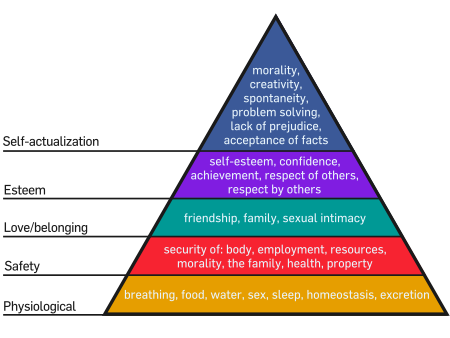
The reason for this is that happiness does not actually come from having more sticks. Happiness comes from getting all one's needs fulfilled. To bring in another bit of psychological theory, let's look at Maslow's Hierarchy of Needs for a minute, not only because it's useful but because it's pretty:


As Maslow's triangle shows, property/money/the bundle of sticks (finite resources) are only automatically relevant to our most basic needs. And the truth is that we don't really need that much to satisfy those needs. We don't need a giant mansion and a fast car and a boat and barrels of caviar to be secure, healthy, nourished, and free. Those things might contribute to how we are esteemed, of course...but only because our culture has chosen to esteem wealth and "power over" above other possible values such as skill, kindness, conservation of resources, and "power with." The markers of wealth might also help "buy us love," but the relationships gained will be no more stable and happy (and often less so) than relationships based on other values. And nothing at the pinnacle of the triangle--self actualization--can be bought or gained through property. Neither can self-actualization be attained through the exploitation or appropriation of someone else's rights to personhood. (Note: although Maslow's Hierarchy is useful, it's not perfect. I am generally anti-hierarchy, and therefore would argue that none of these needs are more crucial than any other, but that all are equally necessary.)

I've talked a lot about privilege in this post and it's gotten far longer than I intended. But I also want to address a slightly different, but still related, example of the zero-sum game myth. This version of the zero-sum game sets the individual against community--in other words, it tells us that the good of the individual runs counter to the good of the community. It also assumes that a society that values the individual can't also value the community, and vice versa.

There are certainly cultures that value one or the other--our American culture values the individual over the community, for instance, while many traditional and tribal cultures value the community over the individual. However, the idea that individual freedoms must be sacrificed to benefit one's community or that community values are undermined by permitting individual expression is a falsehood. There is no inherent conflict between the two, provided that one of the values upheld by the community is individual self-actualization and recognition of individual freedoms. (This assumes that damaging another person is not an individual right. "An it harm none, do what you will.")

I think the zero-sum game myth about individual v. community fuels a lot of American fear about the evils of socialism. We look at socialist or communist countries like China, where individual freedoms are severely restricted, and we see that as the only option. However, the valuing of community cohesion to the exclusion of individual expression is a characteristic derived from Chinese culture and interpersonal tradition rather than an inherent characteristic of socialism. Admittedly, that particular cultural aspect is probably one of the reasons why socialism was easily accepted by the Chinese. But it was a sufficient characteristic of that acceptance, not a necessary one. American socialism would have to look very, very different. Unfortunately, because part of our cultural tradition is entrepreneurial greed and isolationist self-interest, we have a long way to go before we can enter a real middle ground of individual in relationship to community rather than in conflict with it.

There are two associated themes here that I see as recurring. One of these is the theme of abundance philosophy versus scarcity philosophy. The other is a theory of love, approach, and cooperation versus a theory of fear, isolation, and conflict. I've touched on each of these a bit, but there is, of course, much, much more to be said.

Sunday, March 21, 2010

Mid-Degree Crisis

It has become apparent to me during the course of my study of anthropology that I'm meant to be a theorist rather than a technician. Not for me the digging up and sexing of bones, the detailed nuance of pottery patterns, the observation of primate behavior. In fact, the watching of contemporary people is almost too concrete for me, though I know it's going to have to make up part of the foundation for my theorizing. The point is, the information I seek out and immerse myself in is essentially philosophical.

In the aftermath of post-modernism there seems to be a structural void. This may be my inexperience and incomplete education talking, but the upshot of post-modernism on anthropology has been the nearly discipline-wide conviction that everyone's story is just as valid as the next person's. The Big Bang theory is just as true to physicists as the theory that humankind was made from mud and the breath of the gods is to many cultures around the globe. Anthropologists work hard to make ourselves believe that it is supremely culturally insensitive to privilege any system above another, especially our own. I completely support this stance, while subjectively believing in the system that works for me. I think that I can only ever speak definitively for my own experience and understanding and that it would be both naive and arrogant to assume that I speak for anyone else.

Add into this mix an in-depth study of epistemology--that is, the nature of knowing. How do we know what we know? How do we know that what we know is valid? What makes what we know better than what they know? My most trusted mentors encourage me to read as much as possible and to spend time searching myself to find out where I stand theoretically. Yet there's no mistaking their parallel goal of passing on their position to you as a protege. The position that I've been synthesizing from my studies and my professors is simply this: everything that ever is or was or will be is subjective and arbitrary. More simply: nothing has any value except that which we give it.

This is a revelation to me which has far-reaching repurcussions not just for my academic and professional development, but for my personal life as well. What this means to me is that reality is entirely malleable. I can make decisions that are outside social norms, but if they make me happy and fulfilled, I'm not an outlier, I am simply myself, fulfilled. The not-quite-as-constructive upshot is that I am now almost completely adrift academically. If nothing means anything, then what is the point of studying anything?

Any work I publish will only be my own observations, opinions, and thoughts, filtered through the theories and historical background already laid by others, true, but essentially it all seems very self-serving at this point. Anything is a valid field for study, anything I want. But what will the results mean? Can I really ever say anything meaningful about anything if it's all relative and particular to the moment in time and space where my observations were made? Can any of that particular information be extrapolated out to apply to humanity at large? Should that even be a goal?

So now I find myself at a crossroads. My faith in the value of my studies is shaken, and now it's hard to find motivation to take any classes or work hard in them. This is not just anthropology, but life I'm talking about here--do I pick a system to buy into or do I now spend the rest of my life developing and living by my own system? Can my life mean anything if I do that? I do want to make a lasting contribution to humanity, to leave the world a little better than I found it, but I'm not so sure anymore that that's possible. Again, terrifying...and liberating.

Redefining Justice, Part 2: Moving From Fear to Mutual Benefit

Kohlberg's stages of moral development provide a psychological concept I think is relevant to the creation of an evolved society and therefore an evolved justice system. Currently, our justice system works on the lowest level of the hierarchy--using fear of punishment to exert control. It's pretty well established by experts in child development that negative reinforcement or punishment is the least effective way to change behaviors. Positive reinforcement--reward for good behavior--is more effective (Kohlberg's stage 2 and 3). An ideal system would work primarily on the level of Kohlberg's stage 5--in which the system is truly designed to benefit everyone and in which exceptions are provided for--and support an approach to stage 6 (in which criminal justice should no longer be necessary because of a more expansive or universal consciousness). The goal of such a system would be to render itself obsolete.

....Or, what about a system that dealt with people on their individual levels of moral development? If you've got someone who only understands Stage 1, then sure, mere punishment may be appropriate. But most adults probably operate somewhere between Stage 2 and Stage 5. Doesn't it make more sense to change people's behavior by meeting them at their level of understanding?

Another set of ideas that seems relevant is Lakoff's metaphoric contrast of the strict father morality common to conservative thought to the nurturing parent model followed by liberal moral philosophy. The strict father morality assumes the worst of humanity--that children and by extension people have evil inherent in their nature and need to be tightly controlled for their own benefit--while the nurturing parent assumes the best, protecting and empowering his or her children to make the best choices for themselves independently. Another well-known tenet of child development, especially education, is that expectations can be self-fulfilling prophecies. How can people develop higher moral functioning if they are never given the opportunity to exercise it? What kind of parent do we want our governing system to emulate?

Here are some characteristics that I believe would be essential to a working, nurturant justice system.

Justice is available to all and not for sale. Equal justice under the law is a right, not a privilege. Putting a premium on effective legal representation makes this right meaningless. One way to restore meaning to the right of representation would be to abolish private criminal practice; another way would be to either provide private representation to everyone, or hire and pay enough public defenders to represent everyone as if they were paying clients. However, I tend to favor a more radical solution: eliminate our current adversarial system and therefore the need to create an equal playing field. I may talk about this in more detail later.

A focus on finding the truth, rather than assigning blame. In many cases, law enforcement and courts are looking for a scapegoat for societal wrongs and individual suffering, rather than trying to discover the truth of what really happened. If someone gets punished, they can say that justice is done and keep the public happy. (This is another argument against the adversarial system, in which both sides are encouraged to focus on winning rather than finding and revealing the truth, despite the extensive lip service paid to fact finding.)

Proactive rather than prescriptive crime prevention. Harsh penalties do not appreciably reduce crime. Equitable economic and social policies would do far more towards deterrence. One of the major motivations for people to engage in crime is financial gain, and for the poor folks that make up the majority of our prison population, financial need. Eliminating poverty and economic need would eliminate the motive for a large percentage of property crime. Furthermore, happy, empowered people are less likely to experience and express violently aggressive urges, and they are more likely to look kindly on a system of governance that truly protects and provides for them.

Cultural factors also play into our astronomical rates of violent crime. It's hardly surprising that a patriarchal culture which upholds violence, hard control, and power over as the defining traits of masculinity would suffer from high rates of antisocial behavior. If to be masculine is to be powerful, to be the most masculine is to be the most powerful, and beating, raping, or killing someone may seem worth it to gain that kind of power--especially to those who have been otherwise completely disempowered.

Focus on rehabilitation rather than retribution. Assuming that there will always be people who cannot be rehabilitated, that number is very small compared to the total number of criminal offenders. For most, when isolation from society is warranted due to antisocial or violent tendencies, that isolation should be in the context of treatment and education rather than punishment, and the term of isolation should be based on improvement rather than set penalties. Efforts should be made to determine what led people to offend in the first place and how to change that internal or external situation. Treatment should focus on individual empowerment.

I do feel that great care should be taken with sexual predators and abusers, those who prey on the weak and tend to repeat their patterns of violence. We don't really know what makes a sociopath or a compulsive sex offender. It's my suspicion that these individual sicknesses come from a greater, societal sickness, some of which is based in traditional models of masculinity and some of which emerges from the extreme amounts of shame imposed upon sexual desire. However, once entrenched, those predatory tendencies may be difficult or impossible to change. In such extreme situations, the goal should be to remove that person completely from any opportunity of recidivism, by life imprisonment or capital punishment, provided it could be administered fairly. (I am not a moral absolutist: I believe that there are situations in which killing is justified.)

Let the punishment fit the crime. We currently use imprisonment as a catch-all penalty for felonies and even some misdemeanors. As mentioned in the first part, a few years in prison can escalate criminal tendencies and behavior. Instead, consequences for criminal behavior should be specific in nature to the behavior itself, not just in degree. It should focus on creating a remedy for any harm done to its victims, if possible, while reducing the motivation to commit similar crimes.

Eliminate social policies that create opportunities for crime. I'm thinking drug policy, here. Our society's regulation of recreational drugs, including its arbitrary exception for alcohol, is completely illogical and raises millions of dollars for people willing to break the law. Fully acknowledging the damage wrought by addiction and the health risks associated with psychoactive drugs, these substances will always be in demand. Outlawing them creates a market and inflates prices, increasing the reward for import, export, and distribution. Make them legal, regulate them, and you put drug lords out of business. The fact that we haven't gotten here yet--here, at least--is ridiculous.

This is a brainstorming post. The system I envision is one which is truth-centered rather than adversarial, is protective rather than retributive, is focused on positive individual outcomes for offenders and victims, is fair and proportional in assigning consequences, operates in the context of sane cultural values, and is backed up by rational, coherent, and compassionate social policies.

I think values are a big part of this discussion, actually. Shifting the value systems of our culture from capitalist self-interest to a more community-based, morally advanced, universal awareness would be essential to the attainment of truly just governance. As always when it comes to cultural change, there's a chicken and egg problem: it's hard to institutionalize a value system if people don't subscribe to that system, and it's hard to change cultural values within a system that is so entrenched in the old value system.

Redefining Justice, Part 1: Orwell Would Be Proud

What does "real justice" look like?

I've been thinking a lot lately about prison reform, about the failures of our common law system, and trying to define for myself what "justice" really means. Like most Big Important Words, it's used to mean a lot of things in our culture: getting what you're entitled to, getting what you deserve, getting your basic rights, equal treatment, holding someone accountable, being punished, etc.

To narrow this topic a little bit, I'm going to stick to talking about criminal justice and specifically incarceration and capital punishment as instruments of "justice," since these punitive sentences are the primary way our system deals with most crimes from drug offenses to murder. However, I think that there are serious problems with our system of civil justice and some of them echo the problems in the criminal justice system.

Generally, criminal penalties are assigned several different purposes: deterrence, retribution and the prevention of "self-help" or vigilante justice, public safety (i.e. "getting criminals off the streets"), and rehabilitation. It's my position that our system fails pretty consistently to serve these functions.

Deterrence is the traditional justification for harsh penalties. Yet, rampant crime--including extremely high levels of violent crime--continues in our society, indicating that our system of penalties doesn't provide a good enough deterrent. Also, whether a punishment acts as a deterrent will differ for different types of crimes and for different kinds of criminals. Our country currently punishes crimes involving drug sales heavily, but many people in the drug trade are involved because they can make far more money with illegal activity than with legitimate employment. The rewards outweigh the risk. Hence, our policy on illegal drugs continues to fail.

I think that, for many people, retribution is still the common meaning of justice. When someone talks about "seeing justice done," they mean retribution. It's a deep, primal human reaction rooted in anger and aggression. When someone is hurt, they want to see the perpetrator hurt in return. An eye for an eye, a tooth for a tooth. In fact, we really want to do the hurting ourselves. Retributive justice is a way to institutionalize and regulate this instinct in order to, as many legal writers have put it, "prevent self-help." Draconian punishments do provide retribution, but retributive justice cannot return a murdered loved one to life or erase physical and psychological damage. There are also many, many cases of victims who receive little or no retributive satisfaction, particularly victims of rape, sexual abuse, and domestic assault, crimes which (without special circumstances such as extreme violence) are punishable by short prison spans despite the incalculable damage wrought by the perpetrators.

The act of removing a dangerous person from society is another justification for long prison sentences and capital punishment. Again, this works for some crimes and criminals and not for others. We know that some criminals are sociopathic or compulsive and will almost certainly re-offend; there's a clear value in removing such people from society. However, taking one drug dealer, car thief, or gang member off the streets only creates a gap which will be filled by someone else. As with deterrence, protective justice as it stands today generally does not work as intended, or work at all. For instance, short terms and parole for repeat sex offenders often leads to (surprise, surprise) repeat offenses.

As for rehabilitation, our justice system pays it a lot of lip service, but spends very little resources on it. The quality and availability of vocational, educational, and treatment programs within our prisons is laughable. In reality, our system does far more to entrench criminal tendencies in its subjects. The prison environment reinforces violent and aggressive tendencies and isolates prisoners from prosocial relationships, replacing any outside support network with a network of presumably antisocial individuals "inside." Furthermore, once released, it is extremely difficult for convicts to get legitimate employment, increasing the likelihood that they'll return to crime to support themselves, perhaps with the assistance of contacts they made in prison.

Since our current system does not actually perform any of these functions of justice effectively, what is its actual purpose? There is one thing the system does do extremely well, and that is enforce the status quo, perpetuating existing hierarchies of power, privilege, class, and opportunity. As our justice system stands now, justice is bought and sold. People without financial resources are almost certain to end up with a conviction and a more severe sentence than those who can pay for legal representation. Public defenders are so overworked and underfunded that they are rarely capable of effective representation. The result is that poor people, a disproportionate number of whom are people of color, are funneled very efficiently into our prisons. Even if the terms for their crimes are short, the conviction on their record ensures that they'll have great difficulty gaining employment once released, providing good reason to return to criminal activity to make ends meet. In fact, the system does not deter criminality, but nurtures it, as efficiently as if it were designed to do so.

A second thing our system does effectively is make money. The criminal justice system is an extremely lucrative business. In the state of California, the Department of Corrections and Rehabilitation is a power unto itself and its union lobbyists pour impressive resources into influencing state prison policy. In other words, our prisons are run and staffed by people who are legitimately profiting from the high levels of crime in our society. Rather than policies and institutions which prevent crimes and protect the vulnerable, we have instead policies and institutions that make people into criminals, harden them, and introduce them to other criminals. It's also no coincidence that our prisons leach money from our education system and social programs. Promoting public ignorance and desperation serves the interests of the "corrections" business well.

My conclusion is that, in fine Orwellian fashion, the only thing our system of criminal "justice" does do well is perpetuate violence, crime, and economic and racial injustice. So what would a system that provided meaningful justice look like? I'll suggest some goals for such a system and some ideas about how to construct it in my next post.