I think it's interesting how some strong themes are emerging here. One of the themes that keeps coming up for me is challenging dichotomies. We encounter these dichotomies in the form of false zero-sum games. In so many ways, we are taught that life involves either/or: that to get one thing requires giving up something else, and that someone else having something means that we cannot have it. That in order for one person to be a winner, someone else must lose.
It doesn't have to be that way. We can change the rules of the game. It can be both/and. The game does not have to be adversarial--it can be cooperative. In our world there are plenty of evils to fight against that are not our fellow human beings: poverty, global warming, disease, destruction of resources. If we keep playing--both as individuals and as communities, identity groups, countries--as if the goal is getting all the marbles, everyone is going to eventually lose. Our fates are bound together, now more so than ever. Competition has its place...it can spark innovation and push us to do our best...but it's counterproductive if we forget, as we have collectively forgotten, that the bigger picture is cooperative effort. As a game theorist friend put it, we all look at the world as if we're playing a FPS (first person shooter game) but in reality we're playing an MMO (massively multi-player role playing game). Our survival depends on each person doing their part to benefit the whole.
One of the places this principle emerges for me is the discussion of privilege. There's a tendency of the privileged to hang on desperately to their privilege by denying rights to others, as if rights were a finite and unrenewable resource. Men and women, for instance, are set against each other in the "battle of the sexes." The idea that men lose rights when women gain them is simply a falsehood. Under the adversarial theory, of course, men are losing a crucial advantage. But we're not playing against each other! In a heterosexual context (which is relevant because this battle is generally staged against a backdrop of heteronormativity), men and women are each other's
partners. How the hell does it make sense to play male and female interests against each other when in a sane world, our interests are held in common? How does it make sense to deny someone else's personhood in order to shore up one's own? As I recently said, it's not as if there are a limited number of "person slots" available and we have to fight over them.
To me, the way to replace this negative concept with a more positive paradigm, to unite the supposed opposites, is to move from "privileges" to "rights" and from the idea of "power over" to the idea of "power with." The way our culture currently conceives of power is hierarchical: for one person to have power, another must have less power. Either men have power over women or women have power over men, and to release one's privilege is to submit, to lose. But if we all have
rights, no one has privilege. If we hold power with each other, between each other, for each other, we do not have
less of anything...except, perhaps, the ability to hurt one another. And if we recognize that our interests are held in common, not in conflict--that we are not enemies--we do not need the ability to hurt as defense or offense.
The same applies to other hierarchies of power--white v. people of color, straight v. queer, abled v. disabled. The dichotomies are artificial, even silly, arbitrary. That the color of our skin, our choice of sexual partner, our physical ability, our genitals determine what team we're on is ridiculous. It's foolish. And it truly benefits nobody. Just look at the debate over gay marriage--straight people do not actually benefit in any way by the fact that marriage is a privilege that they possess rather than a right for everyone. Abled people don't benefit by having stairs rather than ramps. White people didn't benefit by having their own drinking fountains (sure, maybe they didn't have to wait as long for a fountain, but having more fountains for everyone would confer
exactly the same benefit).
Of course, it's not always quite that simple. White people, for instance, do benefit from preferential treatment. If there are a certain number of people competing for an apparently limited resource--say, housing--and prejudice is enforced so that white people are selected more often, Caucasian people "win." They do so by essentially eliminating people from the "game" by making them non-persons or lesser persons, with the idea that if there are fewer "person slots," then each person gets more.
But there's something more subtle going on here. The conflict arises because of a perception of scarcity--that there is not enough housing, or not enough quality housing, to go around. In essence, a scarcity of space. And the real problem is not who gets the space, but how we use and understand space in a way that creates scarcity. The real enemy is not other people, but the scarcity itself--and we'd all be better off solving that, not fighting for scraps.
That problem is the result of another level of winning and losing, another game going on behind the scenes. Racial conflicts like the one I've posited occur between people of similar economic status, usually of the lower classes--and the conflict distracts those members of the lower classes, who should be natural allies based on their interests, from realizing that the scarcity does not arise because there's not enough to go around, but because someone else is taking far more than their fair share. While poor and middle class people compete for housing, people in the upper classes maintain multiple dwellings and huge acreages, golf courses and mansions.
Wealth and class also erases and eases other forms of disadvantage and therefore privilege--if you are wealthy and disabled, for example, accommodations are not hard to come by the way they are for the non-wealthy; wealthy women always found it easier to buck societal restraints; wealth allows its possessors to engage in whatever sexual practices they desire. Privilege does not exist among the truly privileged. Neither does scarcity. Because neither concept is rooted in absolute reality. There is, in fact, plenty enough for everyone...it's just that a small number of people are cheating the rest of us by keeping most of the bank out of the game and impressing the rules of privilege and scarcity on the rest of us. In this way, the "bundle of sticks" of property law, positing rights as a limited resource, infects our entire culture with a myth of "not enough"--it keeps us fighting over imaginary or insignificant sticks so that the truly privileged can keep all the real sticks for themselves.
But let's take it one step further. Why do some people want to keep all the sticks to themselves? Are the sticks inherently valuable (beyond the value of having a safe, secure, and private space, which doesn't actually require that much property)? Does having so much more of everything really make people happier? To a certain extent and in some circumstances, it does. Let's return to the example of the rich person in a wheelchair. His or her wealth is the difference between an easy existence and a hard existence. But if accommodations for the disabled were truly treated as a
right...if we built all our buildings with ramps instead of stairs...if disabled people weren't seen as less attractive than abled people...the advantage conferred by wealth vanishes.
Another reason that wealth can bring more happiness is because it brings access to goods of quality. But if quality was treated as a primary value in itself, rather than profit being the highest value above all, there would be no reason to create goods of lower quality so that more could be sold faster. Certainly, creating quality goods requires time and effort, and that could create scarcity...but if there are enough people to create scarcity, there are also enough people, potentially, to put a lot of time and effort into creating things of quality. And since pride in one's craft or work tends to create great satisfaction, the overall result would be more happy people. Instead, we have a lot of unhappy people fighting like dogs over things that are really of very poor quality, and a few theoretically happy people enjoying things of very high quality.
Of course, as we know by exposure to the private lives of celebrities and politicians, wealth does not actually correlate perfectly, or even closely, with happiness and satisfaction. The very wealthy are just as much victims of the bundle of sticks myth as everyone else, believing that if they can just acquire more sticks, they can finally experience happiness. When that happiness continues to elude them, we small-stick-holders often witness them self-destruct in spectacular fashion through drugs and other reckless behavior.
The reason for this is that happiness does not actually come from having more sticks. Happiness comes from getting
all one's needs fulfilled. To bring in another bit of psychological theory, let's look at
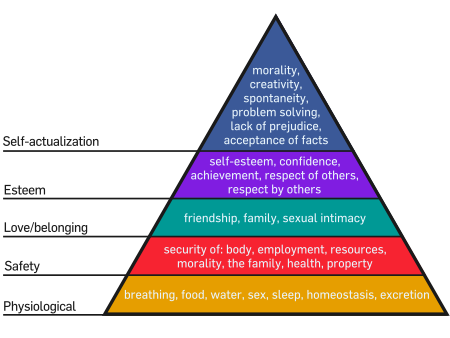
Maslow's Hierarchy of Needs for a minute, not only because it's useful but because it's pretty:

As Maslow's triangle shows, property/money/the bundle of sticks (finite resources) are only automatically relevant to our most basic needs. And the truth is that we don't really need that much to satisfy those needs. We don't need a giant mansion and a fast car and a boat and barrels of caviar to be secure, healthy, nourished, and free. Those things might contribute to how we are
esteemed, of course...but only because our culture has chosen to esteem wealth and "power over" above other possible values such as skill, kindness, conservation of resources, and "power with." The markers of wealth might also help "buy us love," but the relationships gained will be no more stable and happy (and often less so) than relationships based on other values. And nothing at the pinnacle of the triangle--self actualization--can be bought or gained through property. Neither can self-actualization be attained through the exploitation or appropriation of someone else's rights to personhood. (Note: although Maslow's Hierarchy is useful, it's not perfect. I am generally anti-hierarchy, and therefore would argue that none of these needs are more crucial than any other, but that all are equally necessary.)
I've talked a lot about privilege in this post and it's gotten far longer than I intended. But I also want to address a slightly different, but still related, example of the zero-sum game myth. This version of the zero-sum game sets the individual against community--in other words, it tells us that the good of the individual runs counter to the good of the community. It also assumes that a society that values the individual can't also value the community, and vice versa.
There are certainly cultures that value one or the other--our American culture values the individual over the community, for instance, while many traditional and tribal cultures value the community over the individual. However, the idea that individual freedoms must be sacrificed to benefit one's community or that community values are undermined by permitting individual expression is a falsehood. There is no inherent conflict between the two, provided that one of the values upheld by the community is individual self-actualization and recognition of individual freedoms. (This assumes that damaging another person is not an individual right. "An it harm none, do what you will.")
I think the zero-sum game myth about individual v. community fuels a lot of American fear about the evils of socialism. We look at socialist or communist countries like China, where individual freedoms are severely restricted, and we see that as the only option. However, the valuing of community cohesion to the exclusion of individual expression is a characteristic derived from Chinese culture and interpersonal tradition rather than an inherent characteristic of socialism. Admittedly, that particular cultural aspect is probably one of the reasons why socialism was easily accepted by the Chinese. But it was a sufficient characteristic of that acceptance, not a necessary one. American socialism would have to look very, very different. Unfortunately, because part of our cultural tradition is entrepreneurial greed and isolationist self-interest, we have a long way to go before we can enter a real middle ground of individual in relationship to community rather than in conflict with it.
There are two associated themes here that I see as recurring. One of these is the theme of abundance philosophy versus scarcity philosophy. The other is a theory of love, approach, and cooperation versus a theory of fear, isolation, and conflict. I've touched on each of these a bit, but there is, of course, much, much more to be said.